The annual cost of a loan to a borrower. Like an interest rate, an APR is expressed as a percentage. Unlike an interest rate, however, it includes other charges or fees (such as mortgage insurance, most closing costs, points and loan origination fees) to reflect the total cost of the loan.
An amount paid to the lender, typically at closing, in order to lower the interest rate. Also known as mortgage points or discount points. One point equals one percent of the loan amount (for example, 2 points on a $100, 000 mortgage would equal $2, 000).

The estimated monthly payment includes principal, interest and any required mortgage insurance (for borrowers with less than a 20% down payment). The payment displayed does not include amounts for hazard insurance or property taxes which will result in a higher actual monthly payment. If you have an adjustable-rate loan, your monthly payment may change once every six months (after the initial period) based on any increase or decrease in the Secured Overnight Financing Rate (SOFR) index, published daily by the New York Fed. Note: Bank of America is not affiliated with the New York Fed. The New York Fed does not sanction, endorse, or recommend any products or services offered by Bank of America.
Today's 30 Year Mortgage Refinance Rates
Also called a variable-rate mortgage, an adjustable-rate mortgage has an interest rate that may change periodically during the life of the loan in accordance with changes in an index such as the U.S. Treasury-Index (T-Bill) or the Secured Overnight Financing Rate (SOFR) published daily by the New York Fed. Bank of America ARMs generally use SOFR as the basis for ARM interest rate adjustments. Note: Bank of America is not affiliated with the New York Fed. The New York Fed does not sanction, endorse, or recommend any products or services offered by Bank of America.
Your monthly payment may fluctuate as the result of any interest rate changes, and a lender may charge a lower interest rate for an initial portion of the loan term. Most ARMs have a rate cap that limits the amount of interest rate change allowed during both the adjustment period (the time between interest rate recalculations) and the life of the loan.
The details of this estimate requires some additional assistance from one of our loan specialists. Please contact us in order to discuss the specifics of your loan.
Bank Of America Cd Rates
We offer a wide range of loan options beyond the scope of this calculator, which is designed to provide results for the most popular loan scenarios.
Chart data is for illustrative purposes only and is subject to change without notice. Advertised rate, points and APR are based on a set of loan assumptions (refer Loan assumptions and disclosures above for important information). Your actual rate and APR may differ from chart data. Chart accuracy is not guaranteed and products may not be available for your situation. Monthly payments shown include principal and interest only, and (if applicable), any required mortgage insurance. Any other fees such as property tax and homeowners insurance are not included and will result in a higher actual monthly payment. Advertised loans assume escrow accounts (monthly collection of subject property taxes and any applicable homeowners insurance with your monthly principal and interest payment) unless you request otherwise and the loan program and applicable law allows. Should you choose to waive escrows, your rate, costs and/or APR may increase. ARM interest rates and payments are subject to increase after the initial fixed-rate period (5 years for a 5y/6m ARM, 7 years for a 7y/6m ARM and 10 years for a 10y/6m ARM; the 6m shows that the interest rate is subject to adjustment once every six months thereafter). Select the About ARM rates link for important information, including estimated payments and rate adjustments.You’re reading a free article with opinions that may differ from The Motley ’s Premium Investing Services. Become a Motley member today to get instant access to our top analyst recommendations, in-depth research, investing resources, and more. Learn More
The Federal Reserve's interest rate hiking spree over the past couple of years has been a double-edged sword for banks. Higher rates make lending a more profitable business. But they also work against economic growth, crimping banks' other profit centers. The key for these institutions is to maximize the upsides from lofty interest rates while limiting their downsides.
Mortgage Refinance Options
So how has Bank of America (BAC 0.68% ) fared in the middle of this tug-of-war? Not quite as well as many investors were hoping it would. If you own its stock, you've certainly got something to keep an eye on. If you don't own it, there may be better options out there to buy right now.

Federal Reserve Chairman Jerome Powell and his colleagues must walk a fine line, to be sure. Unchecked inflation can up-end an economy. Excessive interest rates enacted to stem that inflation can do the same. The Fed must find and maintain a healthy, sustainable balance between the two.
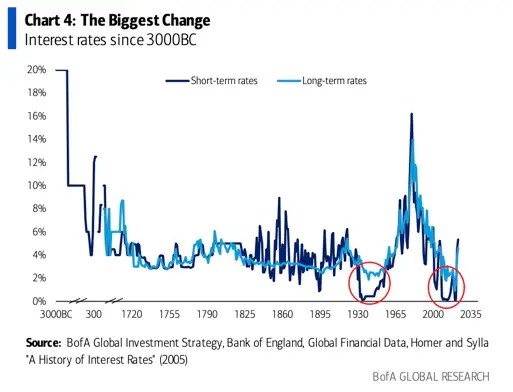
To this end, the Fed's recent streak of interest rate increases feels awfully aggressive. A year and a half ago, the federal funds rate was practically zero, while the prime rate was just above 3%. Since then, the prime rate has soared to 8.25% -- a jolting change over such a short period of time.
Here's Why Bank Of America Is A Good Stock In A Rising Rate Environment
The thing is, inflation had been racing upward since early 2021. And from its peak of 9.1% in June 2022, those rate hikes have helped bring it back down to 3.2% in July 2023. The Federal Reserve has actually done a pretty good job of responding to a tricky and serious situation.
Can Bank of America say the same after being forced to adapt quickly to the changing economic backdrop? After all, higher interest rates make for more profitable loans, but they also make loans much less marketable.
The image below tells the tale. You can see the prime rate has continued to edge higher in 2023 since jumping to a multiyear high in late 2022, bringing Bank of America's net interest income higher with it. The trends disconnected early this year, though. Net interest income has eased back from Q4's figure of nearly $14.7 billion to Q2's $14.2 billion despite higher interest rates being seen in the meantime. This tells us the business of making loans is less and less profitable when it should (in theory anyway) be more profitable.
Refinance: What It Is, How It Works, Types, And Example
We can see why this is happening by using other data too. Namely, the size of BofA's loan portfolio has essentially become stagnant, with deposits declining for a couple of quarters now. And its net yield -- the difference between its costs to borrow money and its returns on money it lends out -- was actually down from the fourth quarter's 2.22% to 2.06% in Q2. It was doing better back in 2019 when interest rates were lower and the economy was lethargic. This contraction suggests the bank is being forced to extend relatively generous terms to borrowers.
Higher interest rates aren't just impacting BofA's lending business. With the exception of its market-making services, high interest rates have also coincided with weakening incomes for its other business lines as well.
This makes sense. Although higher borrowing costs don't directly alter the profitability profile of brokerage or credit card services, they do slow economic growth, which in turn diminishes demand for such services. The plunge in Bank of America's investment banking fees, for instance, isn't unique to it. JPMorgan Chase reported lackluster underwriting numbers for its second quarter. Goldman Sachs' Q2 investment banking revenue was down 20% year over year. Not many companies are looking to go public in the current economic environment, and they're certainly not interested in issuing debt at such high interest rates if they can avoid it.

Office Of Research Blog: A Look At Cash Out Refinance Mortgages And Their Borrowers Between 2013 To 2023
In a similar vein, institutional and retail interest in stock and bond trading is tepid. Investors of all ilks seem to understand that sluggish economies don't produce many must-own investments. Meanwhile, banking service charges are fading as well, if only because Bank of America is seeing net withdrawals of deposits.
Bottom line? Taking BofA's market-making services out of the mix, this company's quarterly noninterest income has slipped from its Q4 2021 peak of more than $10.1 billion to less than $8 billion in each of the last three quarters. That's less than it was generating with these businesses back in 2019 when economic headwinds led the Fed to start dialing back interest rates.
When you start drilling into the data and find that higher interest rates may be doing the bank more harm than good, however, it understandably raises concerns. When will deposits start perking up again? How narrow will the profit margins on BofA's lending activities become now that they've started shrinking? For that matter, how long can revenues from Bank of America's market-making services offset weakness on other fronts?
Wells Fargo Rejected Over Half Of Black Applicants For Refinance Mortgages
The analyst community says BofA shares are currently undervalued; the stock's current price of less than $29 is 18% under the consensus price target of $35.37. Don't be too eager to embrace this implied upside, though. There's a reason the stock's still falling


Posting Komentar untuk "Refinance Interest Rate Bank Of America"