Our Scorecard ranks every state’s health care system based on how well it provides high-quality, accessible, and equitable health care. Read the report to see health care rankings by state.
A doctor and nurses tend to a patient at University Hospital Leipzig on Nov. 18, 2021, in Leipzig, Germany. Germany spends less on health care per capita than the U.S., yet life expectancy at birth is nearly four years higher. Photo: Jens Schlueter/Getty Images

With the pandemic a continuing threat to global health and well-being, we have updated our 2019 cross-national comparison of health care systems to assess U.S. health spending, outcomes, status, and service use relative to Australia, Canada, France, Germany, Japan, the Netherlands, New Zealand, Norway, South Korea, Sweden, Switzerland, and the United Kingdom. We also compare U.S. health system performance to the OECD average for the 38 high-income countries for which data are available. The data for our analysis come from the Organisation for Economic Co-operation and Development (OECD) and other international sources (see “How We Conducted This Study” for details).
The Evolution Of Healthcare: Us Healthcare Since 1990
For every metric we examine, we used the latest data available. This means that results for certain countries may reflect the height of the COVID-19 pandemic, when mental health conditions were surging, essential health services were disrupted, and patients may not have received the same level of care.
In all countries, health spending as a share of the overall economy has been steadily increasing since the 1980s, as spending growth has outpaced economic growth.
In 2020, when the COVID-19 pandemic began, health care spending rose rapidly in nearly all countries, as governments sought to mitigate the spread of the disease through COVID testing, vaccine development, relief funds, and other measures.
Universal Health Coverage In Latin American Countries: How To Improve Solidarity Based Schemes
In 2021, the U.S. spent 17.8 percent of gross domestic product (GDP) on health care, nearly twice as much as the average OECD country.
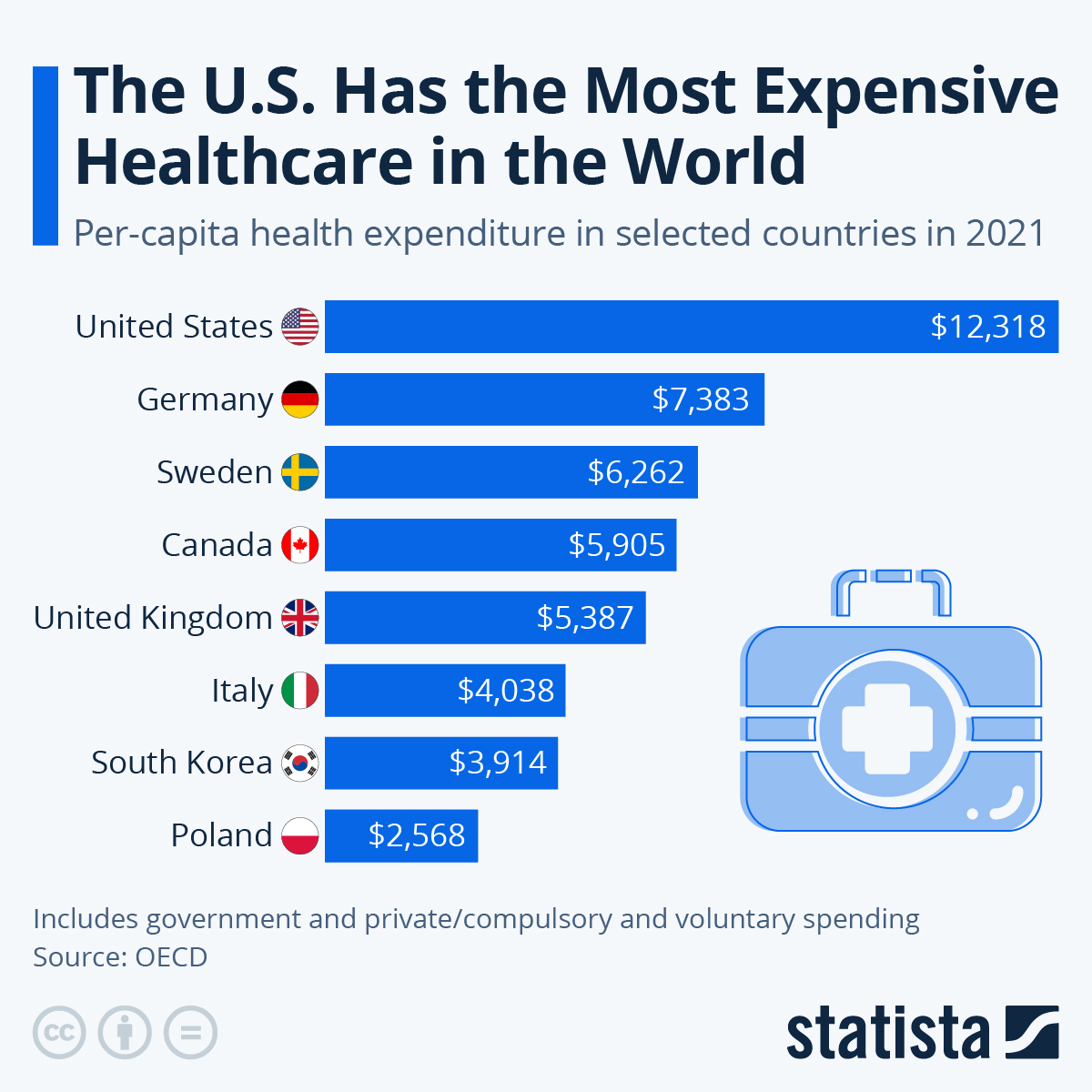
Health spending per person in the U.S. was nearly two times higher than in the closest country, Germany, and four times higher than in South Korea. In the U.S., that includes spending for people in public programs like Medicaid, the Children’s Health Insurance Program, Medicare, and military plans; spending by those with private employer-sponsored coverage or other private insurance; and out-of-pocket health spending.
All countries in this analysis, except the U.S., guarantee government, or public, health coverage to all their residents. In addition to public coverage, people in several of the countries have the option to also purchase private coverage. In France, nearly the entire population has both private and public insurance.
How Does Cost Affect Access To Healthcare?
Despite high U.S. spending, Americans experience worse health outcomes than their peers around world. For example, life expectancy at birth in the U.S. was 77 years in 2020 — three years lower than the OECD average. Provisional data shows life expectancy in the U.S. dropped even further in 2021.
Average life expectancy in 2019 for non-Hispanic Black Americans (74.8 years) and non-Hispanic American Indians or Alaska Natives (71.8 years) is four and seven years lower, respectively, than it is for non-Hispanic whites (78.8 years).
Meanwhile, life expectancy for Hispanic Americans (81.9 years) is higher than it is for whites and similar to life expectancy in the Netherlands, New Zealand, and Canada. As a group, Asian Americans have a higher life expectancy (85.6 years) than people in Japan.
Costs Of Caring
Avoidable mortality refers to deaths that are preventable and treatable. Preventable deaths can be avoided through effective public health measures and through primary prevention, such as nutritional diet and exercise. Treatable mortality can be avoided mainly through timely and effective health care interventions, including regular exams, screenings, and treatment.
Since 2015, avoidable deaths have been on the rise in the U.S., which had the highest rate in 2020 of all the countries in our analysis.
In 2020, the infant mortality rate in the U.S. was 5.4 deaths per 1, 000 live births, the highest rate of all the countries in our analysis. In contrast, there were 1.6 deaths per 1, 000 live births in Norway.
How Americans View Use Of Ai In Health Care And Medicine By Doctors And Other Providers
Women in the U.S. have long had the highest rate of maternal mortality related to complications of pregnancy and childbirth. In 2020, there were nearly 24 maternal deaths for every 100, 000 live births in the U.S., more than three times the rate in most of the other high-income countries we studied. A high rate of cesarean section, inadequate prenatal care, and socioeconomic inequalities contributing to chronic illnesses like obesity, diabetes, and heart disease may all help explain high U.S. infant and maternal mortality.

The U.S. is an outlier in deaths from physical assault, which includes gun violence. Its 7.4 deaths per 100, 000 people is far above the OECD average of 2.7, and at least seven times higher than all other high-income countries in our study, except New Zealand.
Obesity is a key risk factor for chronic conditions such as diabetes, hypertension and other cardiovascular diseases, and cancer. Issues that contribute to obesity include unhealthy living environments, less-regulated food and agricultural sectors, lower socioeconomic status, and higher rates of behavioral health problems.
Our Healthcare System Seems Evil
The U.S. has the highest obesity rate among the countries we studied, where data was available — nearly two times higher than the OECD average.
In 2020, three of 10 U.S. adults surveyed said at some point in their lifetime they had been diagnosed with two or more chronic conditions such as asthma, cancer, depression, diabetes, heart disease, or hypertension. No more than a quarter of residents in the other countries studied reported the same, and the U.S. rate was nearly twice as high as France’s.
Since the start of the COVID-19 pandemic, more people in the U.S. have died from the coronavirus than any in any other high-income country. For every 1 million cases between January 22, 2020, and January 18, 2023, there were more than 3, 000 deaths in the U.S.
Here's How Broken The U.s. Healthcare System Is
While U.S. health care spending is the highest in the world, Americans overall visit physicians less frequently than residents of most other high-income countries. At four visits per person per year, Americans see the doctor less often than the OECD average.
Less-frequent physician visits may be related to the comparatively low supply of physicians in the U.S., which is below the average number of practicing physicians in OECD countries.

The average length of a hospital stay in the U.S. for all inpatient care was 4.8 days, far lower than the OECD average. The U.S. had 2.8 hospital beds per 1, 000 population, lower than the OECD average of 4.3.
Why Doesn't America Have Universal Health Care? One Word: Race
More than two-thirds of older Americans receive the flu vaccine, similar to older residents of several other high-income countries, and more than the OECD average.
The U.S., however, has one of the lowest COVID-19 vaccination rates among high-income countries. As of January 2023, 69 percent of the population were fully vaccinated, compared to 86 percent in South Korea, although rates are regularly being updated.
The U.S. does relatively well with cancer prevention. This is likely a reflection of extensive screening and detection, a key to diagnosing breast and colorectal cancers early and beginning treatment in a timely manner.
Envisioning The Evolution Of Learning Healthcare Systems To A Learning Healthcare Community
The U.S. and Sweden had the highest number of breast cancer screenings among women ages 50 to 69, notably higher than the OECD average. In contrast, just 43 percent of women ages 50 to 69 were screened in France. When it comes to colorectal cancer screening, the U.S. exceeded the OECD average and had among the highest rates.
Magnetic resonance imaging, or MRI, is a common and effective imaging technique for diagnosing and tracking the treatment of a variety of illnesses. The countries that use these specialized scans the most are the U.S., Japan, France, Norway, and Germany, with more than 100 scans per 1, 000 people.
The U.S. has a high number of MRI units available to physicians, about 38 units for every 1 million people in 2018. That’s the second-highest rate in the world behind Japan, which has 51.7 units per 1 million people.
How Does The Quality Of The U.s. Health System Compare To Other Countries?
That’s 42 percent more than the U.K.’s average cost and 420 percent more than Australia’s. And while MRIs are accessible in the U.S., Americans spend far more on them than their international peers do.
Globally, rates of hip replacement are increasing as populations age and develop conditions like osteoarthritis — the leading reason for the procedure, which can substantially improve an individual’s quality of life.
While the United States spends more on health care than any other high-income country, the nation often performs worse on measures of health and health care. For the U.S., a first step to improvement is ensuring that everyone has access to affordable care. Not only is the U.S. the only country we studied that does not have universal health coverage, but its health system can seem designed to discourage people from using services.
What Makes The Healthcare System In America So Bad?
Affordability remains the top reason why some Americans do not sign up for health coverage, while high out-of-pocket costs lead nearly half of working-age adults to skip or delay getting needed care.
The Inflation Reduction Act, which will help reduce the high cost of certain drugs and cap out-of-pocket costs for older Americans, is a step in the right direction.
A second step is containing costs. Other countries have achieved better health outcomes while spending much

Posting Komentar untuk "Healthcare System In America Articles"