We Value Your Feedback Take a moment to tell us about your reading habits, so we can continue improving your browsing experience Start Survey
Yesterday, British Conservative MPs‘ attempt to block high-risk vendors’ such as Huawei from UK telecommunications networks failed. Amid the battle against coronavirus, China and the US continue their race in 5G technology. China is widely acknowledged to be a leader in 5G, but is the US really falling behind? Professor Zhu Ying weighs up opinions on both sides of the debate.

Red-hot spending data over the recent Spring Festival in China caused the stock market in Hong Kong to rise three days in a row after it resumed trading first, with the country’s A-shares following suit a few days later. How long will this recovery in spending and such positive market sentiments last? Will this allow the Chinese economy to shake off fears of deflation and get over its confidence crisis? What other stabilising measures will the authorities introduce?
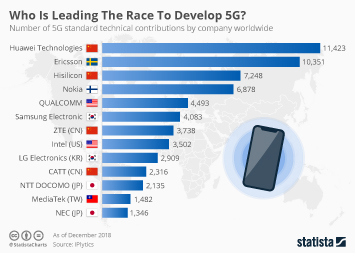
Chart: Who Is Leading The 5g Patent Race?
Liu Jianchao could become China’s next foreign minister. While he could improve China’s outreach efforts, he is unlikely to bring about any significant change in China’s foreign policy.
The US’s “small yard, high fence” strategy of restricting key technologies from China would be difficult to effect in practice. The fact is that products such as semiconductor chips from China are essential in many downstream industries such as the automotive industry, and even security concerns would not stop their use.
Cambodia and Japan have elevated their bilateral ties and both sides have room to delve deeper into strategic matters such as maritime security, a priority both countries have emphasised. But this is not without challenges, given different positions in the ensuing China-US rivalry.
U.s., China 'race To 5g' Rages On
Southeast Asian countries like Vietnam, Malaysia and Singapore are welcoming shifts in the semiconductor supply chain with Taiwan’s TSMC at its heart. Academics Karl Lee Chee Leong and Nur Shahadah Jamil examine the issue.
The spotlight of the global 5G race is cast squarely on China and the US. Influential figures and organisations in China claim that the country is leading the world in 5G technology. While the US admits that Huawei has built more 5G base stations than American companies, it disputes the claim that China is ahead in 5G technology.
In February 2019, Huawei indicated on its official website that “Huawei is the leading provider of 5G solutions”. On 26 October 2019, Ni Guangnan, an academician of the Chinese Academy of Engineering, said, “When it comes to 5G, China is making faster progress than the rest of the world. Every Chinese city is embarking on 5G deployment. Do you see the same being done elsewhere in the world?” On 14 December 2019, ZTE senior vice president, Liu Jian, commented that China is at the forefront of 5G technology, and that Huawei and ZTE are 10 to 11 months ahead of Ericsson and Nokia in terms of 5G technology.
Navigating The Us China 5g Competition
There are two aspects to the statement that China is a world leader in 5G technology: firstly, that Huawei is the global number one in terms of 5G network deployment, and secondly, that both Huawei and ZTE lead the world in 5G technology.
Western countries do agree that China is the world leader in 5G network deployment. On 4 January 2020, an article in Die Welt warned that excluding Huawei would result in frequent network outages in Germany, higher fees for German consumers, and up to several years of delay in network deployment for Germany. On the other hand, the claim that Huawei’s 5G technology is world-leading has not been backed by any influential figure in the West.
Instead in February 2019, Cisco Systems published its Cisco Visual Networking Index report. The report forecast that in the year 2022, the US would still be the leader in the 5G realm. On 20 March 2019, the CEO of AT&T, Randall Stephenson, commented that China has not defeated the US in the 5G race. In an April 2019 report published by Analysys Mason, a global telecommunications research firm, China and the US were ranked joint first globally in terms of 5G readiness.
Us Attacks Huawei And China, Without Its Own 5g Strategy
In September last year, James Lewis, a senior vice president of the United States Center for Strategic and International Studies, said during a media interview, “China is doing pretty well currently, but their claims of dominating the 5G market is political propaganda. What is certain now is that Chinese companies are fully reliant on American suppliers for their 5G businesses. As for technological leadership, the US and Japan are still the heavyweights. While no country can claim to dominate the 5G market, none can produce 5G equipment without American components.”
On 1 December 2019, Steven Mollenkopf, CEO of Qualcomm rejected the claim that China is ahead of the US in the 5G race, but agreed that both countries are on par in terms of building 5G base stations. On 4 December 2019, the Frankfurter Allgemeine Zeitung quoted an expert who felt that claims of Huawei leading the 5G race are merely propaganda by the company and the Chinese government. According to Matthew Noble, an expert with Bird & Bird, telecommunication operators buy Huawei products because they are cheaper, but “have no idea which company is more technologically advanced”. The cost of building a telecommunication network using Huawei products is 20 to 30% lower than using products from other suppliers. He also opined that in terms of actual contribution to the progress of 5G technology, Ericsson, Samsung and Qualcomm are in the top three, followed by Nokia. While Huawei may have applied for a number of 5G patents, it is the quality and not the quantity of the patents that matters.

Pundits in Western countries do not agree that Huawei has world-leading 5G technology because the company relies on the US for the crucial chips used in the 5G equipment it produces. This is analogous to Huawei erecting a skyscraper with a foundation manufactured by the US, or a cutting-edge, Chinese-made fighter jet outfitted with a Russian engine. That is also why Chinese public opinion was unstinting in rebuking the US’s clampdown on Huawei and ZTE. It is also the reason Chinese leaders are now emphasising the need for the country to develop “proprietary core and crucial technologies so that it can become stronger”.
The U.s. Is Winning The Race To 5g
Huawei is a major player and among the leaders in the 5G competition, but critics point out that its chips are made with US technology. (Adrian Dennis/AFP)
Additionally, the scope of 5G technology is very broad. 5G technology aims to fulfil three objectives: enhanced Mobile Broadband (eMBB), Ultra Reliable Low Latency Communications (URLLC), and massive Machine Type Communications (mMTC). This involves more than 10 different types of technologies that are under development, including massive Multiple-Input Multiple-Output (MIMO), New Radio (5G NR), beamforming, millimetre wave, and network slicing etc.
Complicating matters further, not all telecommunication operators intend to deploy all the different technologies. For instance, an operator may prefer to install small, millimetre-wave units in order to achieve high-density, everywhere coverage. At the same time, another operator may be more concerned with beamforming technology instead. The diverse offerings of 5G technology means that it is difficult to envisage one company becoming the world leader in all the technologies it has an interest in. In fact, it may not even be possible for a company to grasp all the 5G technologies.

Race For 5g Supremacy, The: Why China Is Surging, Where Millennials Struggle, & How America Can Prevail: Groves, Austin, Schulte, Paul: 9789811222719: Amazon.com: Books
...it is impossible for a country to have the upper hand in all the technologies involved. Instead, different technologies would be dominated by different companies or countries.
Adam Segal, a technical expert at the United States Council on Foreign Relations, feels that even though China is switching on its 5G networks first, the race is not over. American companies can still dominate the applications and services that run over 5G, just like what they have been doing in the 4G era. The first few killer applications for 5G may well come from the areas of autonomous vehicles, augmented reality, and virtual reality that American companies are working on. In this regard, 5G technology goes beyond network equipment to include applications.
For example, the autonomous-vehicle sector alone encompasses three core domains: sensors, semiconductors, and software. Autonomous vehicles generally run on alternative fuels. This means that both autonomous vehicles and their alternative-fuel batteries are the products of global supply chains that have manufacturing, research, development functions. Therefore, it is impossible for a country to have the upper hand in all the technologies involved. Instead, different technologies would be dominated by different companies or countries. The outcome is that countries around the world would need to split up the work and cooperate in order to gain the high ground in technology and production. Presently, it is still premature to say which country is leading in the application of 5G technology.
New 5g Developments Took The Spotlight This Week Including Kt Corporation's Highly Advanced 5g Skyship
People watch an immersive video introduction to Qualcomm 5G technology at the Las Vegas Convention Center during CES 2019 in Las Vegas, January 2019. (David McNew/AFP)

In the face of technological globalisation, what can China do? On numerous occasions, the Chinese public have heard their state leaders’ calls for greater self-reliance. But, at the New Economy Forum held in

Posting Komentar untuk "America 5g Race"