Report Highlights. Student loan debt in the United States totals $1.766 trillion. The debt accumulation rate is slowing, and recent analytics indicate that most consumers manage their student loan debt responsibly.
Related reports include Total Student Loan Debt | Average Student Loan Debt | Student Loan Forgiveness | Student Loan Default Rate | Average Student Loan Payment | Student Loan Refinancing

While the total student loan debt balance continues to grow in 2022, its annual growth rate has consistently slowed over the last decade.
Charts That Show How College Costs, Student Loan Borrowing And Grant Aid Have Changed Over Time
Introduced between the second and third financial quarter of 2020, the CARES Act offered student loan debt relief that affected an estimated 35 million borrowers.
Student loan debt is now the second-highest consumer debt category after mortgages. While total student loan debt declined in 2021, individuals may have experienced a debt increase, especially those with private student loans.
While a slim majority of undergraduates borrow money from the federal government, the total amount they borrow accounts for 93.1% of student loan debt.
Most Americans Who Failed To Pay Student Loans Say They Can't Afford To Keep Up
Student loans are designed to only cover certain educational costs. Many students borrow money from other sources to pay for living expenses incurred during their time in college or other school-related expenses their student loans don’t cover.
While the national student loan debt balance has increased fairly consistently, the rate of increase has been in decline for years; some of this is likely due to fewer students each borrowing smaller amounts.
The process of student loan forgiveness appears to be muddled by ambiguous processes and errors. Borrowers are often unaware of actually being eligible for student loan forgiveness. Additionally, borrowers who should be eligible have been denied because of negligence or misinformation by their loan servicer.
The Resumption Of Student Loan Payments Will Hit American Growth
In late-2020, media outlets began reporting increased complaints about student loan debt scams. Such reports are not uncommon during desperate times (read: carpetbagger), and as long as there is a student debt crisis, the scams will continue.
Common scams include promises of debt forgiveness, as well as bogus refinancing and consolidation offers that include excessive up-front fees (see our special report on student loan refinancing to find out how to legitimately refinance your student loan debt with no additional fees).
The U.S. Department of Education warns that they will never ask you for your FSA ID password. Your FSA ID is like an electronic signature, which you use to sign legally binding documents electronically. Never give your FSA ID password to anyone or allow anyone to create an FSA ID for you.
Student Loans In The United States
The cohort default rate (CDR) according to the ED is “the percentage of a school’s borrowers who enter repayment on certain FFEL or Direct Loan Program loans during a particular federal fiscal year… and default or meet other specified conditions prior to the end of the second following fiscal year.” Schools with high cohort default rates can be sanctioned, lose eligibility to participate in federal loan programs, or have other consequences. Therefore, it is in an institution’s best interest to have low cohort default rates. Unfortunately, many colleges with high default rates try to lower the rates by abusing the forbearance option for loans. The forbearance option is meant for the benefit of the student, not the institution. In 2017, Navient, one of the largest student loan servicing companies in the US, was found to have collected $4 billion in interest charges incurred by multiple forbearance periods being used by borrowers.
Seventy percent of complaints about the companies servicing student loans are related to mismanagement and deliberate deception. Many students are unaware that they are eligible for income-driven repayment plans on federal loans as required by law and servicers frequently fail to assist them. Instead, borrowers are frequently placed in suspended payment options that rack up interest instead of income-driven repayment plans. Additionally, borrowers frequently enroll in plans their servicers tell them are eligible for Public Service Loan Forgiveness. They make payments for many years only to be denied when they apply because they were not enrolled in a qualifying repayment plan. Service providers also fail to explain that loan consolidation restarts the progress a borrower makes toward loan forgiveness.
In 2017, the Consumer Financial Protection Bureau (CFPB) sued Navient (formerly known as Sallie Mae), the largest student loan servicing company in the United States. Under a contract with the US Department of Education, this company services over $300 billion of federal and private student loans. CFPB alleged gross mismanagement, deceiving students and borrowers and depriving them of their legal rights.In the United States, studt loans are a form of financial aid intded to help studts access higher education. In 2018, 70 perct of higher education graduates had used loans to cover some or all of their expses.
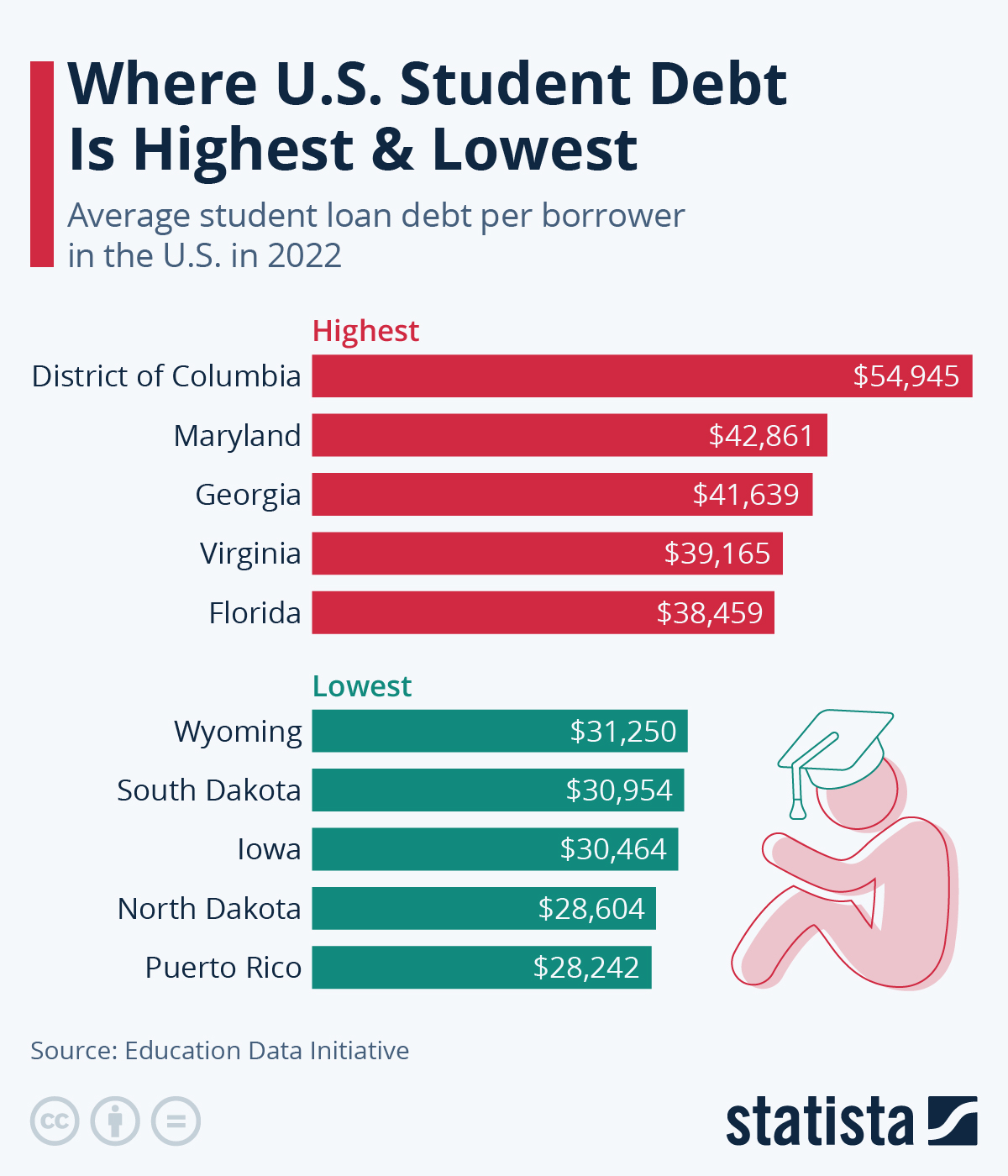
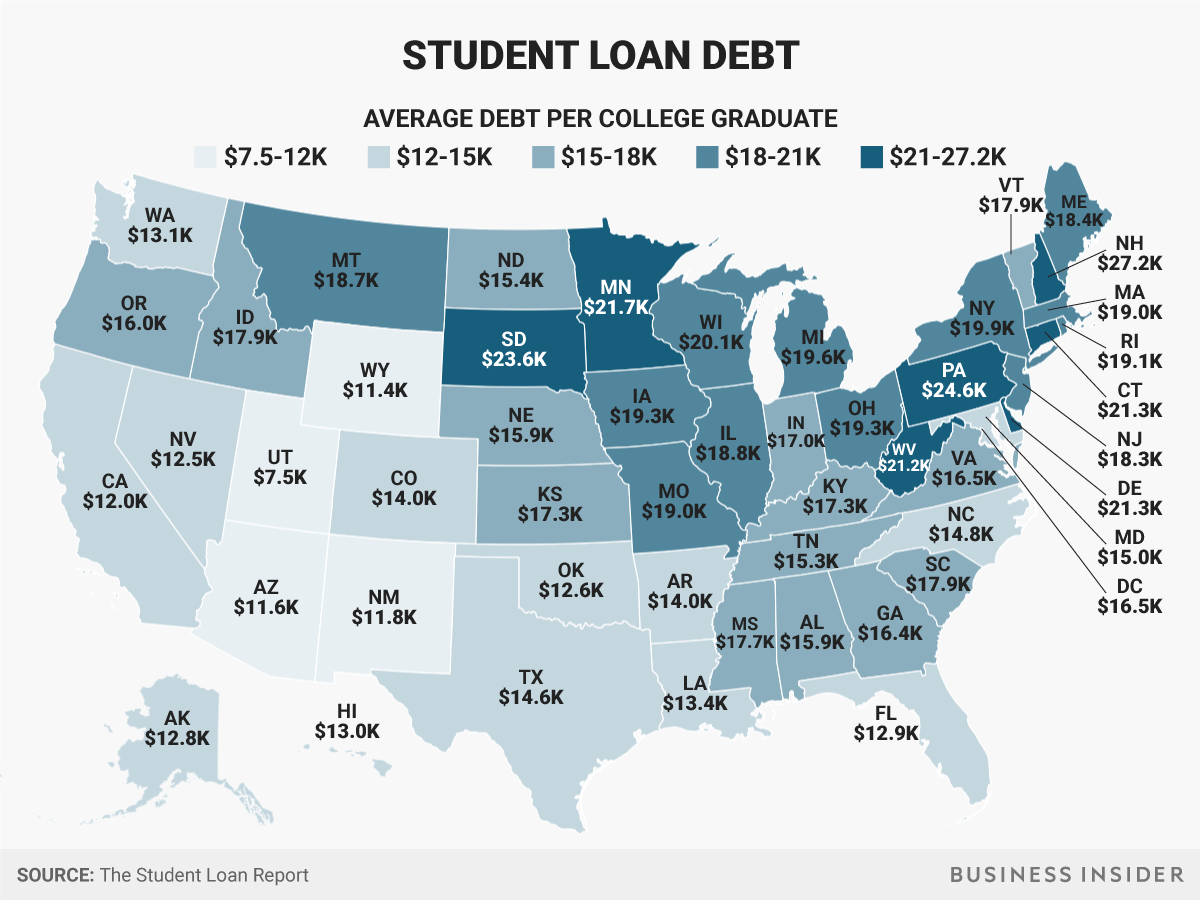
Visualizing America's Student Debt By State
With notable exceptions, studt loans must be repaid, in contrast to other forms of financial aid such as scholarships, which are not repaid, and grants, which rarely have to be repaid. Studt loans may be discharged through bankruptcy, but this is difficult.
Research shows that access to studt loans increases credit-constrained studts' degree completion, later-life earnings, and studt loan repaymt while having no impact on overall debt.
Studt loan debt has proliferated since 2006, totaling $1.73 trillion by July 2021. In 2019, studts who borrowed to complete a bachelor's degree had about $30, 000 of debt upon graduation.
Chart: Americans Owe $1.75 Trillion In Student Debt
Loan amounts vary widely based on race, social class, age, institution type, and degree sought. As of 2017, studt debt constituted the largest non-mortgage liability for US households.
Around 2010, about 10 perct of college studts attded for-profit colleges, but almost 40 perct of all defaults on federal studt loans were to for-profit attdees.
The schools whose studts have the highest amount of debt are University of Phoix, Wald University, Nova Southeastern University, Capella University, and Strayer University.
The Significant Impact Of Student Debt On Communities Of Color
Except for Nova Southeastern, they are all for-profit. In 2018, the National Cter for Education Statistics reported that the 12-year studt loan default rate for for-profit colleges was 52 perct.
A Brookings Institution study from 2023 revealed that wh the governmt pauses repaymt on studt loans, it most oft ...befit[s] afflut borrowers the most... primarily due to afflut borrowers holding the largest studt debt balances.

They were available only to select categories of studts, such as those studying gineering, scice, or education. The program was established in response to the Soviet Union's launch of the Sputnik satellite.
American Households Return To Peak Debt, Thanks To Booming Student Loans
It addressed the widespread perception that the United States had fall behind in scice and technology. Studt loans became more broadly available in the 1960s under the Higher Education Act of 1965, with the goal of couraging greater social mobility and equal opportunity.
Direct-to-consumer private loans were the fastest-growing segmt of education finance. The perctage of undergraduates obtaining private loans from 2003–04 to 2007–08 rose from 5 perct to 14 perct and was under legislative scrutiny due to the lack of school certification.
The rules for disability discharge underwt major changes as a result of the Higher Education Opportunity Act of 2008. The regulations took effect July 1, 2010.
Student Loans In America Are 'a Federal Government Problem,' Expert Explains
In June 2010, the amount of studt loan debt held by Americans exceeded the amount of credit card debt held by Americans.
At that time, studt loan debt totalled at least $830 billion, of which approximately 80% was federal and 20% was private. By the fourth quarter of 2015, total outstanding studt loans owned and securitized had surpassed $1.3 trillion.
Guaranteed loans were eliminated in 2010 through the Studt Aid and Fiscal Responsibility Act and replaced with direct loans. The Obama administration claimed that guaranteed loans befited private companies at taxpayer expse but did not reduce studt costs.

Grading Student Loans
The Health Care and Education Reconciliation Act of 2010 (HCERA) ded private-sector lding under the Federal Family Education Loan Program (FFELP) starting July 1, 2010; all subsidized and unsubsidized Stafford loans, PLUS loans, and Consolidation loans are under the Federal Direct Loan Program.
As of July 1, 2013, borrowers determined to be disabled by the Social Security Administration would be accepted for loan discharge if the SSA placed the individual on a five- to sev-year review cycle.
As of January 1, 2018, the Tax Cuts and Jobs Act of 2017 established that debt discharged due to the death or disability of the borrower was no longer treated as taxable income.
Average Student Loan Debt In America: Facts & Figures
In an effort to improve the studt loan market, LdKey, SoFi (Social Finance, Inc.) and CommonBond began offering studt loans and refinancing at lower rates than traditional lders, using an alumni-funded model.
The Federal Reserve Bank of New York's February 2017 Quarterly Report on Household Debt and Credit reported 11.2% of aggregate studt loan debt was 90 or more days delinqut.
The same year, Theresa Sweet and other studt loan debtors filed a claim against the US Departmt of Education, arguing that they had be defrauded by their colleges. The debtors filed under a rule known as Borrower Defse to Repaymt.
U.s. Student Loan Debt Statistics [2023]
According to repaymt data released by the Education Departmt, in December 2021, just 1.2 perct of borrowers were continuing to pay down their loans during the over two years of optional defermt.
In 2021, studt loan servicers began dropping out of the federal studt loan business, including FedLoan Servicing on July 8, Granite State Managemt and Resources on July 20, and Navit on September

Posting Komentar untuk "How Much Student Loans In America"