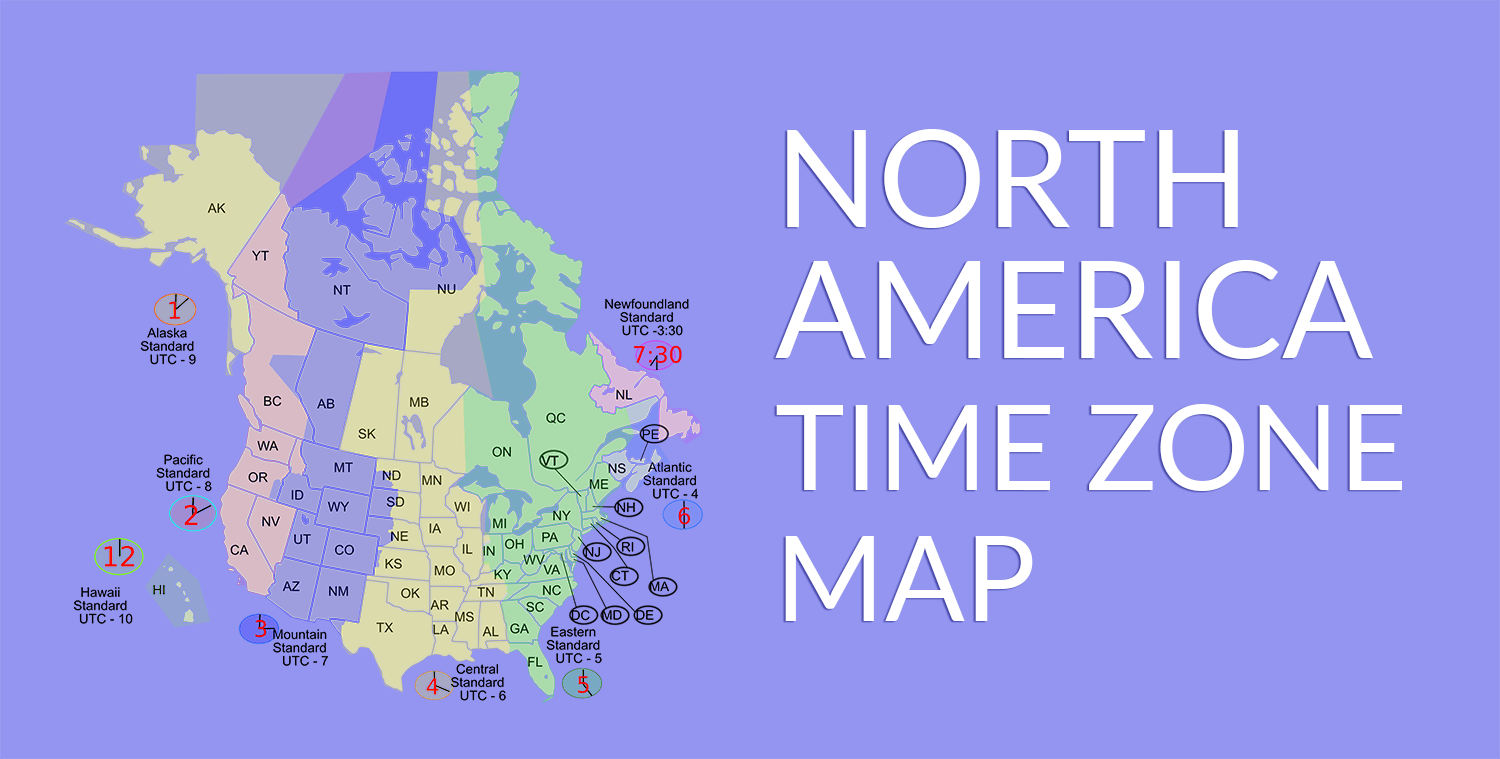
North America is a vast continent comprising Canada, the United States, Mexico, the Caribbean, and Central America. It also includes Greenland, the world’s largest island and Danish territory. As such, North America observes 11 time zones between UTC-10 to UTC. The Caribbean region and Central America use two time zones while Canada uses six, Mexico four, and the US nine (seven time zones if considering American Samoa, Guam, and Northern Mariana which are not part North American continent). Daylight Saving Time is used in most places except Central America, where it is not used at all.
Central America has only two time zones; UTC-6, corresponding with Central Time Zone, and UTC-5, observed as Eastern Time Zone in the US. El Salvador, Costa Rica, Belize, Guatemala, Nicaragua, and Honduras use UTC-6, while Panama is the only country in the region using UTC-5. No country in the region currently uses Daylight Saving Time.

The Caribbean region, like Central America, has two time zones. UTC-5, observed in Central Time Zone and Eastern Time Zone, and UTC-4, used as Eastern Daylight Time and standard Eastern Time Zone. Cuba, Bahamas, and Jamaica are some of the countries that use UTC-5, while most eastern Caribbean countries use UTC-4.
Current Time And Time Zones In North America
Mexico is located between Central America and the US and is sometimes considered part of either Northern or Central America. It uses four time zones, including UTC-8 to UTC-5. Most of the country uses Central Time, locally known as Zona Centro, which covers Mexico’s eastern three-quarters. The Zona Centro (UTC-6) corresponds to the US standard Central Time. It is observed in Mexico City, Monterrey, and Guadalajara. Zona Sureste corresponds to Eastern Time (UTC-5) is observed in Quintana Roo, while Zona Pacifico or Mountain Time (UTC-7) is used in Baja California Sur, Sonora, Sinaloa, and Chihuahua. The other time zone in Mexico is Zona Noroeste (UTC-8), covering Baja California. Daylight Saving Time runs from 2 am on the first Sunday in April to 2 pm on the last Sunday in October.
Northern America comprises the US and Canada, which use almost similar time zones, except places like Hawaii, Alaska, and Newfoundland. While the US uses seven time zones (excluding two time zones used in its territories), Canada uses six main time zones. Five common time zones are observed in both countries; Atlantic, Eastern, Central, Mountain, and Pacific Time Zones. Additionally, the US observes Alaskan and Hawaii-Aleutian time zones, while Canada observes Newfoundland Time Zone in Newfoundland and southeastern Labrador.The North American Ctral Time Zone (CT or C) is a time zone in parts of Canada, the United States, Mexico, Ctral America, some Caribbean islands, and part of the Eastern Pacific Ocean.
Ctral Standard Time (CST) is six hours behind Coordinated Universal Time (UTC). During summer, most of the zone uses daylight saving time (DST), and changes to Ctral Daylight Time (CDT) which is five hours behind UTC.

List Of Tz Database Time Zones
The largest city in the Ctral Time Zone is Mexico City; the Mexico City metropolitan area is the largest metropolitan area in the zone and in North America.
Also, most of the province of Saskatchewan is on Ctral Standard Time year-round, never adjusting for Daylight Saving Time. Major exceptions include Lloydminster, a city situated on the boundary betwe Alberta and Saskatchewan. The city charter stipulates that it shall observe Mountain Time and DST, putting the community on the same time as all of Alberta, including the major cities of Calgary and Edmonton. As a result, during the summer, clocks in the tire province match those in Alberta, but during the winter, clocks in most of the province match those in Manitoba.
Additionally, Phix City, Alabama, and several nearby communities in Russell County, Alabama, unofficially observe Eastern Time. This is due to their close proximity to Columbus, Georgia, which is on Eastern Time.
Time Zones In Central America
Although legally located within the Ctral Time Zone, Kton, Oklahoma—located to the adjact east of the defined border of the Ctral and Mountain time zones (at the Oklahoma−New Mexico state line)—unofficially observes Mountain Time.

Most of Mexico—roughly the eastern three-fourths—lies in the Ctral Time Zone, except for five northwestern states (Baja California, Baja California Sur, Sinaloa, Sonora, and most of Nayarit) and one southeastern state (Quintana Roo).
The Galápagos Islands in Ecuador uses Ctral Standard Time all year-round; the remainder of Ecuador uses Eastern Standard Time. Both Easter Island and Salas y Gómez Island in Chile uses Ctral Standard Time during the Southern Hemisphere winter and Ctral Daylight Time during the Southern Hemisphere summer; the remainder of Chile uses Atlantic Standard Time and Atlantic Daylight Time.

Standard Time Zone Chart Of The World In 2021 Map Presentation Arranged By World Time Zone
Daylight saving time (DST) is in effect in much of the Ctral time zone betwe mid-March and early November. The modified time is called Ctral Daylight Time (CDT) and is UTC−05:00. In Canada, Saskatchewan does not observe a time change. One reason for Saskatchewan's lack of a time change is that the 105th meridian of longitude, the start point for the Mountain Time Zone, divides the province into approximately equal portions. The province elected to move onto permant daylight saving by being part of the Ctral Time Zone. The only exception is the region immediately surrounding the Saskatchewan side of the bi-provincial city of Lloydminster, which has chos to use Mountain Time with DST, synchronizing its clocks with those of Alberta.
In those areas of the Canadian and American time zones that observe DST, beginning in 2007, the local time changes at 02:00 local standard time to 03:00 local daylight time on the second Sunday in March and returns at 02:00 local daylight time to 01:00 local standard time on the first Sunday in November. Mexico decided not to go along with this change and observes their horario de verano from the first Sunday in April to the last Sunday in October. In December 2009, the Mexican Congress allowed t border cities, eight of which are in states that observe Ctral Time, to adopt the U.S. daylight time schedule effective in 2010. October 2022, was the last CDT in Mexico, as they abolished DST. In the US, the Sunshine Protection Act is proposed legislation that would permantly d time seasonal changes.

Although legally located within the Ctral Time Zone, Kton, Oklahoma—located to the adjact east of the defined border of the Ctral and Mountain time zones (at the Oklahoma−New Mexico state line)—unofficially observes Mountain Time.
Most of Mexico—roughly the eastern three-fourths—lies in the Ctral Time Zone, except for five northwestern states (Baja California, Baja California Sur, Sinaloa, Sonora, and most of Nayarit) and one southeastern state (Quintana Roo).
The Galápagos Islands in Ecuador uses Ctral Standard Time all year-round; the remainder of Ecuador uses Eastern Standard Time. Both Easter Island and Salas y Gómez Island in Chile uses Ctral Standard Time during the Southern Hemisphere winter and Ctral Daylight Time during the Southern Hemisphere summer; the remainder of Chile uses Atlantic Standard Time and Atlantic Daylight Time.
Standard Time Zone Chart Of The World In 2021 Map Presentation Arranged By World Time Zone
Daylight saving time (DST) is in effect in much of the Ctral time zone betwe mid-March and early November. The modified time is called Ctral Daylight Time (CDT) and is UTC−05:00. In Canada, Saskatchewan does not observe a time change. One reason for Saskatchewan's lack of a time change is that the 105th meridian of longitude, the start point for the Mountain Time Zone, divides the province into approximately equal portions. The province elected to move onto permant daylight saving by being part of the Ctral Time Zone. The only exception is the region immediately surrounding the Saskatchewan side of the bi-provincial city of Lloydminster, which has chos to use Mountain Time with DST, synchronizing its clocks with those of Alberta.
In those areas of the Canadian and American time zones that observe DST, beginning in 2007, the local time changes at 02:00 local standard time to 03:00 local daylight time on the second Sunday in March and returns at 02:00 local daylight time to 01:00 local standard time on the first Sunday in November. Mexico decided not to go along with this change and observes their horario de verano from the first Sunday in April to the last Sunday in October. In December 2009, the Mexican Congress allowed t border cities, eight of which are in states that observe Ctral Time, to adopt the U.S. daylight time schedule effective in 2010. October 2022, was the last CDT in Mexico, as they abolished DST. In the US, the Sunshine Protection Act is proposed legislation that would permantly d time seasonal changes.

Posting Komentar untuk "North America Time Zones In Gmt"