The Human Rights Campaign uses cookies to improve your site experience. By using this site, you agree to our use of cookies. To learn more, please read our Privacy Policy.
The Human Rights Campaign Foundation tracks developments in the legal recognition of same-sex marriage around the world. Working with our network of alumni and partners, we lift up the voices of local advocates and share tools, resources, and lessons learned to empower movements for marriage equality. For more information about ’s work in support of marriage equality and the full equal rights for LGBTQ+ people--including protections from violence, discrimination and other issues, visit /Global.
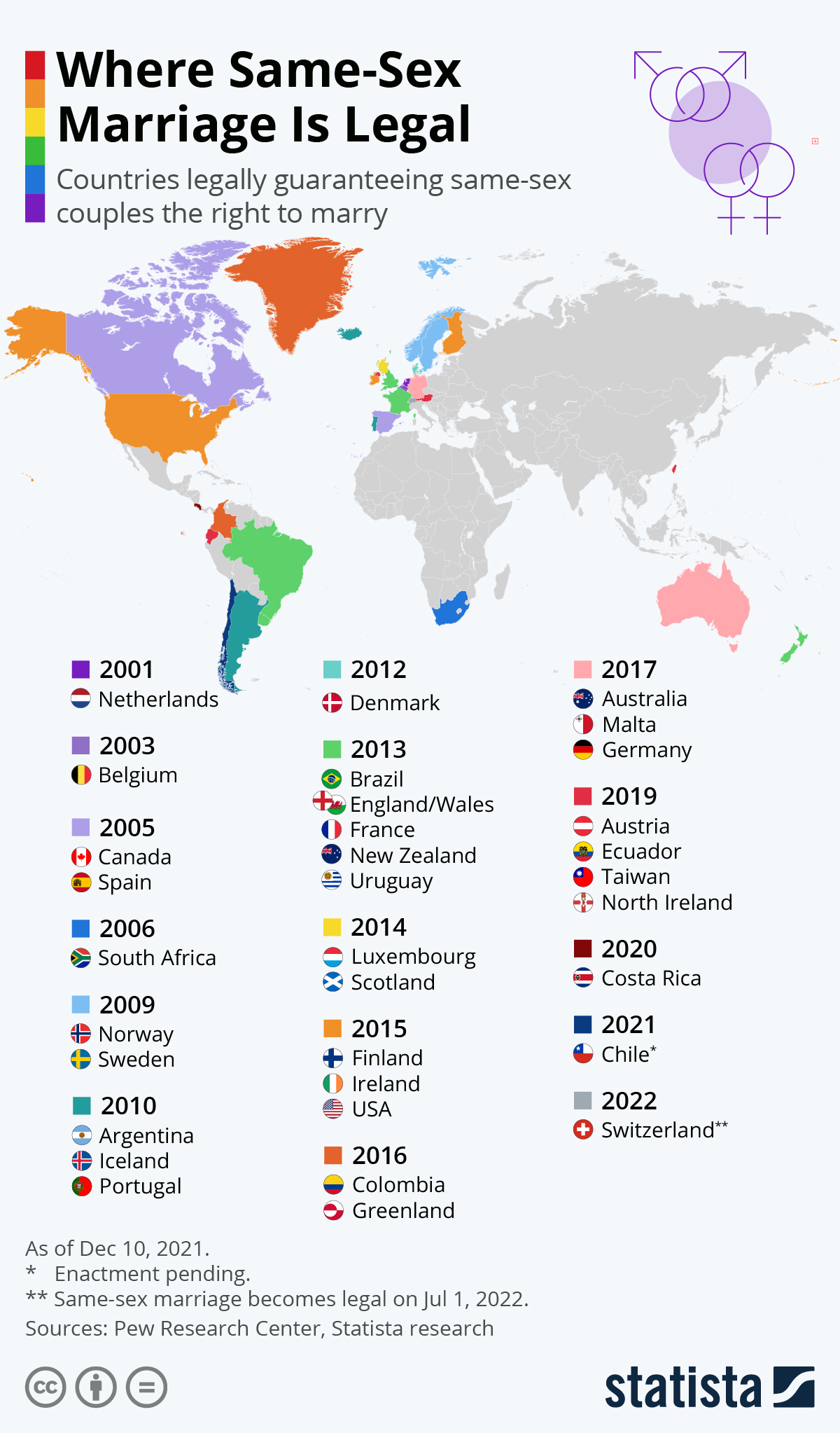
There are currently 34 countries where same-sex marriage is legal: Andorra, Argentina, Australia, Austria, Belgium, Brazil, Canada, Chile, Colombia, Costa Rica, Cuba, Denmark, Ecuador, Finland, France, Germany, Iceland, Ireland, Luxembourg, Malta, Mexico, the Netherlands, New Zealand, Norway, Portugal, Slovenia, South Africa, Spain, Sweden, Switzerland, Taiwan, the United Kingdom, the United States of America and Uruguay.
Colombia Legalises Gay Marriage
Cuba: On September 25, 2022, in a national referendum, Cubans approved a Family Code that included provisions allowing same-sex couples to marry.
Andorra: On July 21, 2022, the unicameral legislature of Andorra, the General Council, voted unanimously to amend the country's civil union law to include marriage equality for same-sex couples.
Slovenia: On July 8th, 2022, the Constitutional Court of Slovenia ruled that the ban on same-sex marriages violated the constitution of Slovenia and gave the Slovenian parliament 6 months to pass legislation accordingly, which it did on October 4. The ruling took effect immediately after the court decision.
Gay Marriage In Latin America
Chile: On December 9, 2021, the president of Chile signed into law a marriage equality bill that passed in the Senate on December 7 and the lower house on Nov. 23. Same sex civil unions had been legal since 2015. Slovenia: On July 8th, 2022, a ruling from the constitutional court of Slovenia decided that the ban on same-sex marriages violated the constitution of Slovenia.
Switzerland: On December 16, 2020, the Swiss Parliament overwhelmingly passed legislation extending marriage to same-sex couples. A public referendum held in September 2021 overwhelmingly confirmed support for marriage equality by 64%.
Costa Rica: The Supreme Court of Costa Rica ruled in November 2018 in support of the historic January 2018 advisory opinion of the InterAmerican Court of Human Rights that marriage equality was consistent with Costa Rica's obligations under the American Convention on Human Rights. The Supreme Court set May 26, 2020 as the deadline for the National Assembly to enact such legislation, but it did not meet that deadline, and marriage equality came into effect on that date.
India: Gay Marriage Recognition Referred To High Court
Austria: The Constitutional Court of Austria ruled on December 4, 2017 that denial of marriage equality was discriminatory, legalizing same-sex marriage. Marriage equality took effect January 1, 2019.
Taiwan: The Taiwan Constitutional Court ruled in 2017 that marriage could not be restricted to opposite-sex couples and gave parliament two years to enact legislation legalizing same-sex marriage. Parliament passed legislation to legalize same-sex marriage which went into effect May 24, 2019, making Taiwan the first country to enact marriage equality in Asia.
Ecuador: Legalized after Ecuador’s Constitutional Court found on June 12, 2019 that its ban was unconstitutional, marriage equality took effect in Ecuador on July 8, 2019.
Where Is Gay Marriage Legal? Guide To Global Marriage Equality
The Inter-American Court of Human Rights is an independent judicial institution of the Organization of American States. In 2018, it issued an advisory opinion to Costa Rica that signatories of the American Convention on Human Rights are obliged to make same-sex marriage legal. The Court’s guidance applies to 20 signatory countries and has proven a powerful tool in advocating for marriage equality in these countries.
The European Court of Justice (ECJ) serves as a high court in the European Union. In 2018, the ECJ determined that all EU countries were required to recognize the same-sex marriages of EU and non-EU citizens for purposes of immigration, regardless of whether same-sex marriage is legal in those countries. In recognition of this decision, the Supreme Administrative Court of Bulgaria affirmed in 2019 that the country would recognize such same-sex marriages for the purposes of immigration.

This page is based on a review of legislation and judicial decisions recognizing same-sex marriage. It does not identify countries that recognize other kinds of relationships between same-sex couples, such as civil unions, registered partnerships or domestic partnerships.
Estonia Legalizes Same Sex Marriage
We note that processes for obtaining a marriage license for same-sex couples in some countries differ across localities, such as in Mexico where, in light of a constitutional court ruling, some states have enacted marriage equality while, in other states, same-sex couples must seek an amparo from a federal court to obtain a license.
Same-sex married couples in many countries do not share all of the same rights and benefits as different-sex married couples, such as the right to adoption. In some countries, same-sex couples also experience additional restrictions. For example, in Taiwan same-sex marriage is only available to Taiwanese citizens or a citizen of a foreign country that recognizes same-sex marriage who seeks to marry a Taiwanese citizen.
The Human Rights Campaign reports on news, events and resources of the Human Rights Campaign Foundation that are of interest to the general public and further our common mission to support the LGBTQ+ community.
Supreme Court Declares Same Sex Marriage Legal In All 50 States
By clicking GO below, you will be directed to a website operated by the Human Rights Campaign Foundation, an independent 501(c)(3) entity.Politics & PolicyInternational AffairsImmigration & MigrationRace & EthnicityReligionAge & GenerationsGender & LGBTQFamily & RelationshipsEconomy & WorkScienceInternet & TechnologyNews Habits & MediaMethodological ResearchFull topic list
While laws allowing same-sex marriage have become more common in European countries and in U.S. states, gay marriage advocates also have gained ground in some parts of Latin America. Most recently, the Mexican Supreme Court issued a ruling making it much easier for gay and lesbian couples to wed.

The Mexican high court decision gave same-sex couples the right to seek a court injunction against state laws banning gay marriage, but it did not technically legalize same-sex unions nationwide. (Gay marriage is currently legal in just a few Mexican states and jurisdictions.)
Supreme Court: Gay Marriage Legal Across Us
Still, the ruling is a major step toward full legalization, which would mean same-sex marriage would be legal in three of Latin America’s four most populous countries – Brazil, Mexico and Argentina – in addition to tiny Uruguay. Among the world’s major regions, only Europe has more countries permitting legal gay marriages.
At the same time, strong conservative social views in many Latin American countries mean that this legal trend may not be primed to spread through the region in the near future.
Among countries where gay marriage is legal, Uruguay is the only place where a majority of the public (62%) supports allowing gay and lesbian couples to marry legally. About half of Argentinians and Mexicans favor gay marriage, while support for allowing same-sex couples to legally wed stands at 45% in Brazil, according to a Pew Research Center survey of Latin America conducted in 2013 and 2014.
Same Sex Marriage Legalized By Supreme Court
In a majority of countries across the region, one-third of adults or fewer favor legal gay marriage, while more than 60% oppose it. For example, 80% of Paraguayans, 74% of Ecuadorians and 64% of Colombians say they oppose same-sex marriage. In much of Central America, opposition also is particularly strong: Roughly three-quarters or more of Hondurans, Guatemalans, Salvadorans and Nicaraguans are against gay marriage.
Aside from those nations that already have legalized gay marriage, Chile is the country most supportive of the idea, yet public opinion on the issue remains divided there. Fully 46% of Chileans favor allowing gay and lesbian couples to wed, compared with 42% opposed. Earlier this year, Chile enacted a law recognizing civil unions (although not full marriage rights) for same-sex couples; Colombia and Ecuador also recognize some form of legal partnerships for gay and lesbian couples.

Across Latin America, the growing Protestant population is more opposed to same-sex marriage than are Catholics or people who say they are unaffiliated with any religion (religious “nones”). While the vast majority of Mexicans are Catholic (81%), the religious divide on the issue is apparent – 50% of Mexican Catholics favor legal gay marriage, compared with 35% of Protestants and 65% of the religiously unaffiliated. Roughly one-in-ten or fewer Mexicans are Protestant (9%) or unaffiliated (7%).
Argentina Legalizes Same Sex Marriages
As is the case in many countries, younger Mexicans are far more likely to favor same-sex marriage than older age groups; 63% of Mexicans ages 18 to 34 voice support for gay marriage, compared with 40% of those 35 and older.
About Pew Research Center Pew Research Center is a nonpartisan fact tank that informs the public about the issues, attitudes and trends shaping the world. It conducts public opinion polling, demographic research, media content analysis and other empirical social science research. Pew Research Center does not take policy positions. It is a subsidiary of The Pew Charitable Trusts.Politics & PolicyInternational AffairsImmigration & MigrationRace & EthnicityReligionAge & GenerationsGender & LGBTQFamily & RelationshipsEconomy & WorkScienceInternet & TechnologyNews Habits & MediaMethodological ResearchFull topic list
Since the first same-sex marriages took place in the Netherlands in 2001, more than 30 other jurisdictions have enacted laws allowing gays and lesbians to marry, mostly in Europe and the Americas.This

Posting Komentar untuk "Gay Marriage Legal South America"