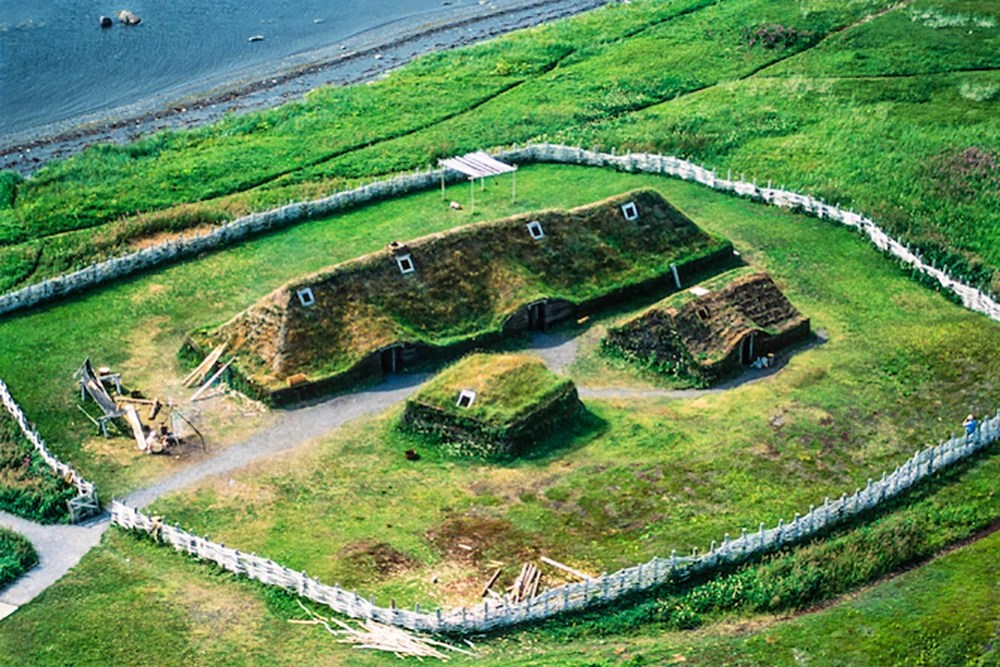
There are a small group of Norse artifacts found in North America that are widely regarded as genuine. These include the artifacts found at L'Anse aux Meadows (left) and the 11
In addition, there are a large number of artifacts not widely accepted as genuine. These range from the carefully studied extant artifacts (such as the Kensington rune stone) to the legendary (such as the Cape Cod ossuary) of which nothing tangible remains.
Since many of the artifacts were found in 's home territory of New England, we present here a summary of some of the more interesting ones, and some of the more bizarre speculation, with the disclaimer that none of these is generally recognized as genuine.
L'anse Aux Meadows
The Boston area is graced with not just one, but three public monuments commemorating Leif's visit to the area. One of these monuments marks the precise location of Leif's house in Cambridge, near the banks of the Charles River. How do we know the location of Leif's travels so precisely?
Century, Eben Norton Horsford, a professor of chemistry at Harvard, felt that he had proof of Norse settlements in several towns along the Charles. Horsford wrote extensively about his findings and had a hand in the creation of the various monuments.
During his life, Prof. Horsford made a fortune through the commercialization of his chemical processes, notably, his process for making baking powder (left). Towards the end of his career, Horsford met Ole Bull, a Norwegian violinist and nationalist who made regular visits to America. Bull catalyzed Horsford's interest in the Vínland settlements. Together, they worked to raise funds to fulfill Bull's dream: a statue of Leif in America. The dream was not realized until after Bull's death, but Horsford saw the project through to its completion. A statue was commissioned and placed on Commonwealth Avenue in Boston (right).
Vikings Arrived In Canada 1,000 Years Ago, New Dating Shows
Subsequently, Horsford decided to search for the location of the Vínland settlement. He used the research methods that had served him so well in his chemical researches. Using the Vínland sagas as his source, he hypothesized the location of Leif's settlement in Vínland.
To test his hypothesis, Horsford started digging at the spot. This was an easy dig, since it was only a few blocks from his home in Cambridge. Horsford found a mishmash of stones (right, taken from the plate opposite page 97 in ref [2]) and proclaimed the site to be that of Leif's home.
Horsford placed the stone tablet (left) which, to this day, marks the location of Leif's house. (The tablet is located at the junction of Memorial Drive and Gerry's Landing Road in Cambridge, between the traffic light at the intersection and the Mt. Auburn Hospital.)
Treasure Hunter Uncovers Huge Stash Of Viking Artifacts
Horsford continued his research, finding evidence of Norse era dams, canals, piers, and settlements in Watertown, and a Norse era fortification in Waltham. Horsford oversaw the re-creation of the fortification: a stone tower in the Norumbega region of the Charles River (right). The tower is located on Norumbega Road, near the intersection with River Road.
Horsford hypothesized an extensive series of North American settlements, with a population of nearly 10, 000 people, which thrived for three centuries. He proposed that the economic basis for the settlements was mazer wood, the round burls (left) that grow on the sides of trees. These burls are valuable for the ease with which they can be worked into bowls, cups, and similar round objects. Horsford hypothesized that the burls were harvested in the forests and floated down to the Charles in canals, for which he claimed to have found physical evidence.
Horsford wrote extensively about his hypotheses. In addition, he summarized his conclusions in a stone tablet in his Norumbega monument. After his death, his daughter continued publicizing and writing about his work. Articles appeared in popular publications as diverse as National Geographic and Popular Science Monthly. Popular travel books of the day guided tourists to the important Norse sites described by Horsford along the banks of the Charles River.
The Vikings In America Linguistic, Biological, Historical, Artifacts, Geographical, Dna And Cultural Evidence Of Norse And American Indian Interrelationships.
Contemporary historians gave little credence to Horsford's theories or his evidence. Other public figures supported him. But as the years passed, and no actual artifacts were produced from any of the sites, it became harder and harder to accept Horsford's conclusions seriously. By the beginning of the 20
[1] Richard R. John, Eben Norton Horsford, the Northmen, and the Founding of Massachusetts, Essays on Cambridge History, Proceedings, 1980-1985. Cambridge Historical Society, 1998.

Grænlendinga saga (chapter 4) says that Þorvaldr Eiríksson led an expedition to Vínland. While there, he and his men battled with Skrælingjar (native Americans). Þorvaldr was wounded by an arrow and died there. Before he died, he asked to be buried near the headland, which he wanted to be known as Krossanes.
The Mysterious Viking Runes Found In A Landlocked Us State
Where is Krossanes? Some people in Hampton, New Hampshire, believe that the Boar's Head promontory (left) at the northern end of Hampton Beach is Krossanes, and that the stone on display at the Tuck Museum is Þorvald's grave marker.
Souvenir hunters chipped away at the stone for years. In 1989, it was moved to its present location at the Tuck Museum, where it was placed in a protective barred cement well.
Hampton does not match very well with the description in the saga. Krossanes is described as a headland between the mouth of two fjords. Before the Skrælingjar attack, it is said they swarmed down one of the fjords towards Þorvaldr and his men. Hampton has nothing remotely like a fjord in its vicinity, and it seems unlikely that two of them have vanished in the intervening 1000 years.
Usa: Viking Artefacts Discovered Near Great Lakes
Prior to the attack, Þorvaldr called the site beautiful and said he wanted to build his farm there and remain for the rest of his life. The marshy area that exists today just inland from the beach does not seem like a very good place for a farm.
The runic carvings on the rock require a great deal of imagination to interpret. If one walks on the boulders near Boar's Head, one can easily find a dozen more specimens where glacial scratches look vaguely like runic characters (left) as well as countless modern runic inscriptions (right).

Over the years, there has been at least one attempt to dig for Þorvald's remains at the original site of the rock. Nothing has been found, which is not surprising, since the soil conditions at the site are not at all conducive to the preservation of materials.
Scientists Raid Dna To Explore Vikings' Genetic Roots
The poor match between the saga description and the geography of Hampton, combined with the dubious runic inscriptions make it unlikely that Krossanes was located in Hampton. A more plausible location is in Newfoundland, or possibly in Nova Scotia. Kelly Point, on the north side of Cape Breton Island, is a headland between two fjords.
While Thorvald's Rock makes for an interesting tourist stop in Hampton, it seems unlikely that Hampton was the final resting place for Þorvaldr Eiríksson.
The Lane Memorial Library in Hampton maintains a nice collection of on-line resources related to Thorvald's Rock, and the Hampton Historical Society has a brief discussion of the rock, and other monuments at the Tuck Museum.
What Have The Vikings Ever Done For Us?
Century, Dighton Rock has rested in the mud of the Taunton River in Massachusetts, fully submerged except at low tide. The rock is a sandstone bolder, a block approximately 1.5m high, 2.5m wide, and 3.4m long (60 x 115 x 130 inches). One side of the block is covered with inscriptions. At low tide, the inscriptions would have been visible to anyone in a boat on the Taunton River. Sketches of the inscriptions exist from as early as the 17
Century interpretation, and suggest the inscriptions were made by bug-eyed aliens. The evidence would seem to support any of these theories equally well.

It's not surprising that scholars can't agree on the origin of the inscriptions; none of the the sketches made over the last three centuries resemble one another, as if even the artists couldn't agree on the appearance of the inscriptions.
A Viking Discovery?
The first known photograph of the rock was taken in 1853. To enhance the inscriptions for the photograph, the inscriptions were filled in with chalk.
What is the probable origin of the inscriptions? I think we can safely reject the suggestion of a Norse origin put forward by Carl Christian Rafn in 1837. Rafn used a sketch provided by the Rhode Island Historical Society, and he is not known to have visited the site to inspect the rock first hand.
Rafn believed that the inscription related to the voyage of Þorfinnur karlsefni to Vínland, described in both Eiríks saga rauða and in Grænlendinga saga. Using characters that are not apparent in the original sketch, Rafn interpreted the text on the rock to read Þorfinnur and his 151 companions took possession of this land.
Beautiful Viking Sword Artifacts That Survived
This explanation seems unlikely on several counts. The rock and the inscriptions are very different from stone inscriptions in Scandinavia known to have been created at the time when Þorfinnur and other Norse explorers were thought to be visiting Vínland. More significantly, Rafn's description of the inscriptions on which he based his interpretation differs considerably from the sketch he is known to have used. One wonders how much wishful

Posting Komentar untuk "Viking Artifacts America"