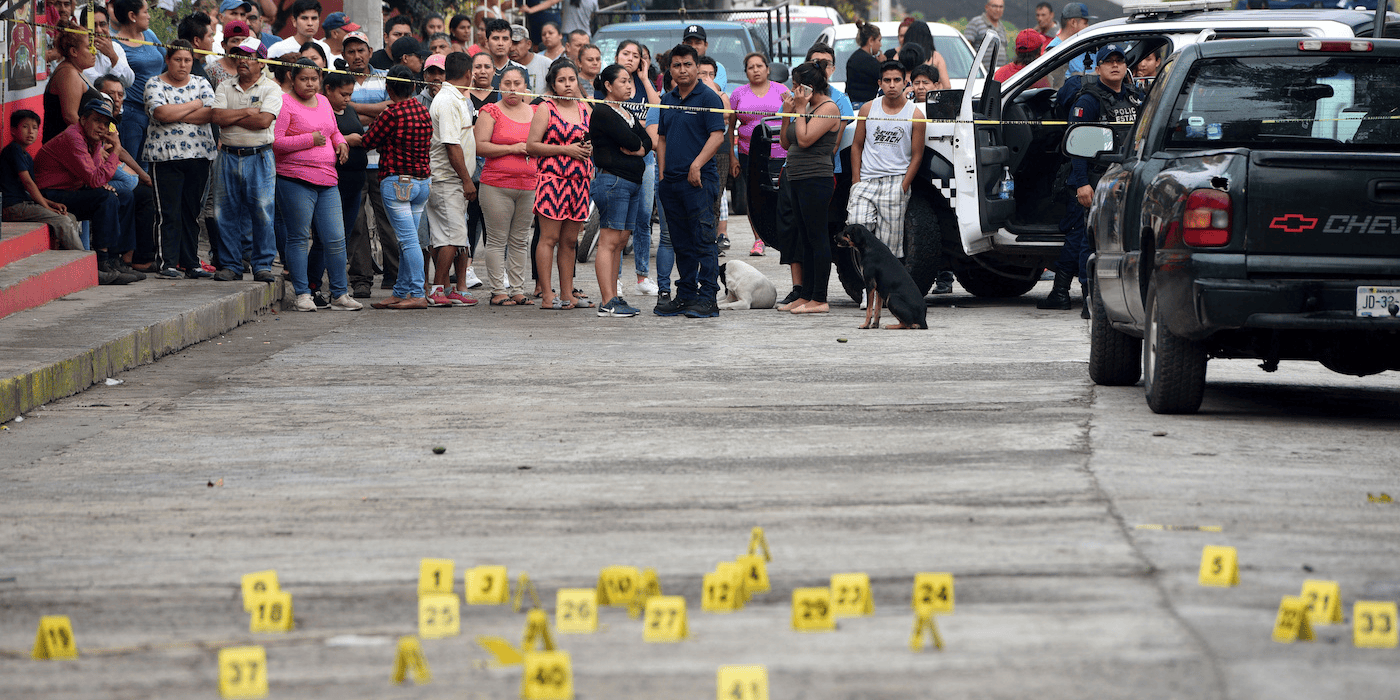
Americas Desk, Apr 11 (EFE).- A majority of Latin American countries are facing a public safety crisis that has grown worse in recent months, with organized crime showing alarming signs of gaining ground amid government inaction and a lack of effective public policy solutions.
But the trafficking of people, arms and migrants, an increase in extortion rackets and other scourges have further exacerbated these nations’ public safety woes – now a top-of-mind issue for ordinary citizens and voters.

It is clear that Latin America is “suffering a setback in terms of security, ” and that problem was made worse by the coronavirus pandemic, Jairo Libreros, an international politics expert and professor of security and national defense at Bogota’s Externado University of Colombia, told Efe.
Pga's Argentinean National Group Expresses Support For Latin American And Caribbean Criminal Court Against Transnational Organized Crime
Although countries like Brazil, Panama, El Salvador, Argentina and Venezuela registered a decline in homicides in 2022, crime remains a major headache for authorities across the region.
In Venezuela, extortion, people trafficking, femicides and sexual abuse are on the rise, while Panama has seen shocking and previously unheard-of violent incidents, including the dismemberment of victims and a mob-style hit inside a school last October that claimed the life of a 15-year-old boy in the northern province of Colon.
Costa Rica, which has long been one of the safest countries in Latin America, registered 656 homicides last year, up 11 percent from 2021 and a record high.
Latin America Is World's Most Violent Region: Un
According to figures from that country’s Judicial Investigation Department, six of every 10 homicides committed in that Central American nation in 2022 were related to a “settling of scores” among drug gangs.
In Chile, the perception on the street is that crime has spiraled to an unmanageable level. Authorities, meanwhile, say the number of crimes is no higher than in previous years, although they acknowledge that the perpetrators have become more violent.
“In simple terms, if you go out today on the street, it’s less likely that someone will rob you compared to 10 years ago. But it’s much more likely that the robber will have a gun and be prepared to use it, ” Interior Minister Carolina Toha said, urging people not to politicize the problem.
Life In London's Mini Latin America Where The Restaurants Are Incredible But Gentrification And Crime Are Destroying The Community
In Ecuador, 10 states of emergency have been declared in the less than two years since conservative President Guillermo Lasso took office.
Salvadoran President Nayib Bukele, for his part, has seen his popularity soar at home – even while facing widespread international condemnation – after authorities rounded up tens of thousands of suspected street gang members under a state of emergency that has been renewed repeatedly over the past year.
In Honduras, a state of emergency also has been in place since December. Initially limited to the two largest cities, Tegucigalpa and San Pedro Sula, it has since been extended to 123 of the country’s 298 municipalities and attracted the concern of the Office of the United Nations High Commissioner for Human Rights.
Stream Latin America News Dispatch
UN agencies and human rights organizations also have criticized the militarization of law enforcement in some countries, such as Mexico, where more than 92, 000 soldiers have been deployed to carry out public safety functions.
Elsewhere, a “police saturation” strategy pursued in Argentina, which consists in putting officers on virtually every street corner, and the recent lifting in Ecuador of a 12-year-old ban on the carrying of firearms by civilians are not real long-term solutions, the director of Argentina’s Center for the Study of Crime and Insecurity in Latin America, Marcelo Bergman, told Efe.

According to Libreros, these are “failed strategies” that have already proved “perverse and toxic” when employed in Latin American countries, Europe and the United States and do not get at the root of the problem.
Latin America's Poverty Is Down, But Violence Is Up. Why?
In Brazil, center-left President Luiz Inacio Lula da Silva, who was inaugurated for a third term early this year, has brought back a security strategy he employed between 2003 and 2010 that consists of boosting the state’s presence in the outskirts of cities via the implementation of social programs.
More police reform is needed to ensure a greater strategic role for civilian government agencies, academia and civil society organizations, according to Liberos, who cautioned against giving officers more freedom to exercise the use of force, as has occurred in Chile with the recently enacted, controversial “Nain-Retamal” law.He told criminal gangs to stop donating food packages during the coronavirus crisis and instead focus on ending the violence which had left more than 100 people dead the previous day.
Mexican cartels are not the only ones who are continuing to operate - organised crime across Latin America, from Colombian gangs to Brazilian urban militias, have continued to display their might throughout the Covid-19 pandemic, as Monitoring's Latin America specialist Luis Fajardo reports.
From Mexico To Chile: The Security Crisis Consuming Latin America
On the afternoon of 7 April, as Colombia experienced its 14th consecutive day under a nationwide quarantine decreed to stem the spread of coronavirus, a large funeral procession made its way through the working-class suburb of Bello in the city of Medellín.
The man who was also known as El Oso (The Bear) was the alleged head of Medellín's powerful Niquía-Camacol criminal gang. He had died the day before of a heart attack while in jail.

Analysts have pointed out that, just like any other business in this unprecedented global health crisis, Latin American crime syndicates face an existential threat owing to the massive disruption to their international supply chains.
Organized Crime Gaining Ground In Latin America Amid Gov't Inaction
Mexican columnnist Héctor de Mauleón has pointed out some of the difficulties faced by the drug cartels. He says that not only have sales of illegal drugs fallen in the United States - the main market for Mexican cartels - but some of the precursor chemicals needed to make the drugs have also stopped arriving from China.
This cocktail heralds a jump in numbers of violent incidents between rival groups: the 'narcos' will be fighting over the scarce criminal opportunities available, Mr de Mauleón writes.
Figures gathered by Mexican daily Milenio seem to back Mr de Mauleón's fears. According to Milenio, March saw the highest monthly total of organised crime-linked homicides in Mexico in 13 years.
Latin America Is The World's Most Dangerous Region. But There Are Signs It Is Turning A Corner
Despite the disruption to their business, Latin American criminal organisations are still attempting to send large volumes of illicit drugs across borders.
So far this year, Colombian security forces have been involved in operations leading to the seizure of 112 tonnes of cocaine, according to Colombian daily El Tiempo.
On 31 March, the Colombian navy intercepted a narco-submarine off Colombia's Pacific coast carrying a tonne of cocaine towards the United States. It was the twelfth such vessel to be seized this year.
A Study Of Journalist Murders In Latin America Confirms The Importance Of Strengthening Protection Policies
Drug cartels have also responded to the current crisis by trying to win over the local population. They have set up informal welfare schemes in communities which face economic ruin from the pandemic and which have received little or no help from the authorities.
Among the Mexican syndicates reported to have handed out food parcels courtesy of their bosses are the Jalisco New Generation Cartel, the Gulf Cartel and Los Viagras.
The extent to which criminal organisations have replaced state functions in Brazil in poor neighbourhoods was brought home when then-health minister Luiz Henrique Mandetta told local officials earlier this month to talk with drug lords and gang leaders about how to stop the spread of coronavirus.
Crime And Violence In Latin American Borders Summer I 2017
Mr Mandetta said that the authorities had to be realistic about who was in power in poor neighbourhoods. We have to understand that these are areas where the state is often absent and the ones in charge are drug traffickers, he said.
It is possible that in the next few weeks or months, a period of enormous weakness for organised crime will be reached, right at the moment when, as a result of the emergency, the state will broaden its faculties, wrote Mexican security expert Alejandro Hope in the Mexican daily El Universal.

But it may be possible to make the most of this state of exception to create state presence where it has never existed, to dismantle the main gangs of organised crime, to subvert their legitimacy, and modify the relationship between citizenship and the security and justice apparatus, Mr Hope argued.
Latin America: Alarming Reversal Of Basic Freedoms
Regardless of the long-term impact on the cartels, in the short term, their efforts to weather the Covid-19 crisis will likely bring continued violence and a persistent challenge to state authorities already struggling with the health emergency across Latin America.

Posting Komentar untuk "Latin America Crime News"